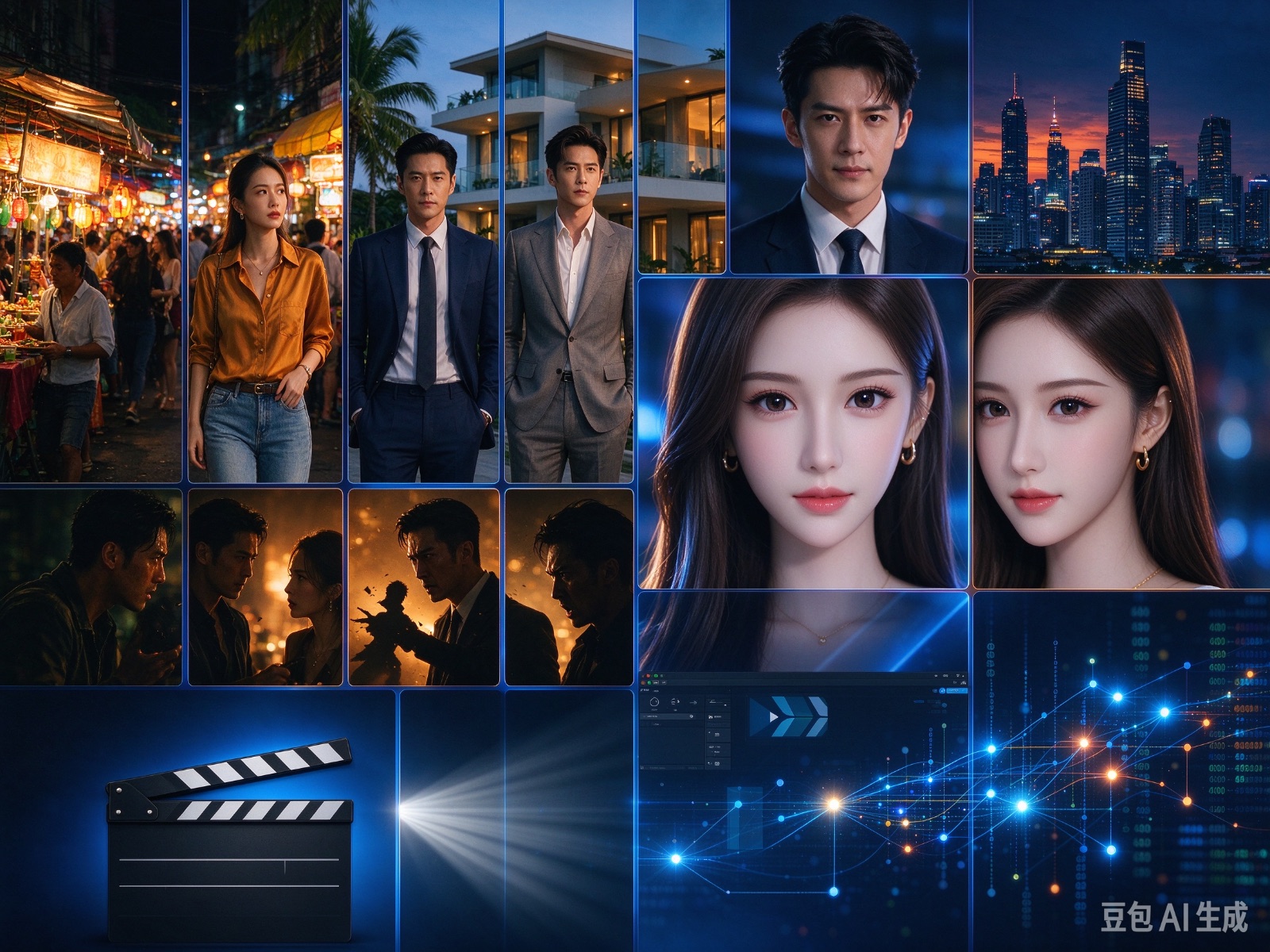
In 2026, the expected overseas micro-drama market size has been revised upward from USD 5 billion to USD 6 billion, with the accelerated industrialization of AI short dramas and animated dramas being one of the important contributing factors; monthly active users of overseas micro-dramas have reached 258 million.
AI Micro-Drama Exports to Southeast Asia: The Market Hits a Tipping Point
2026 marks the year AI fundamentally reshapes micro-drama exports. DataEye has revised the projected overseas micro-drama market for 2026 upward from USD 5 billion to USD 6 billion, driven largely by the accelerated industrialisation of AI micro-dramas and comic dramas. Monthly active users of overseas micro-dramas have reached 258 million. In H1 2026, overseas micro-drama app in-app purchases hit roughly USD 1.27 billion with 1.441 billion downloads, and AI-generated dramas and comic dramas account for nearly 70% of this volume. The overseas AI drama market reached USD 650 million in Q1 2026—a six-fold year-on-year increase—with over 150 million active users, 55% of whom are willing to pay.
Southeast Asia as the Core Testing Ground
Chinese micro-drama export apps have built two monetisation models across ASEAN: paid and free. Thailand generates the highest in-app purchase revenue in ASEAN and is the only ASEAN nation in the global top ten. Singapore, Malaysia and Thailand mainly use standalone paid apps, while Indonesia, the Philippines and Vietnam prefer free ad-supported viewing, with Indonesia having the largest download volume in ASEAN. Emerging markets including Latin America, Southeast Asia and India contribute over 70% of global micro-drama downloads; the Philippines alone accounts for 7%, ranking fourth worldwide.
The Logic of Reverse Adaptation
Traditional long-form drama greenlighting relies on experience-based prediction with high trial-and-error costs. AI micro-dramas work differently: AIGC rapidly generates scripts, virtual characters and footage at far lower cost than live-action, enabling bulk releases into Southeast Asia for real-world user testing. Southeast Asia's large population and high tolerance for ads make it ideal for low-cost script testing, business model validation and initial audience acquisition, while North America suits long-term IP cultivation. This forms the logic of "reverse adaptation": creators launch vertical AI micro-dramas in Southeast Asia, screen hit IPs based on completion, payment and retention metrics, then deploy capital to adapt validated IPs into horizontal long dramas, premium web series or feature films—low-cost market research before large-scale investment.
Emerging Cases
Persian Revenge, a historical fantasy AI micro-drama, achieved USD 500,000 in GMV within 72 hours on overseas platform Your Channel. The Wrathful Vampire, produced by Chinese All Digital, racked up 230 million views within three days on TikTok and hit a 22% payment conversion rate on Sereal+. Chinese All Digital's FlareFlow system incubates original stories on RocNovel, uses reading and payment data to identify storylines worth adapting, then runs an AI pipeline for scriptwriting, character creation, video generation and multilingual localisation. Manufacturers like Yongji Co. position themselves as "AI content production + global distribution + data closed loop" platforms. The model—acquire audiences via micro-dramas first, monetise through long-form content—is being repeatedly validated across Southeast Asia.
Platform & User Feedback: Two Divides
High traffic does not inherently translate into adaptation potential. First, the paid-versus-free divide: Malaysia and Singapore have strong Chinese cultural ties, Thailand has strong payment conversion suitable for hybrid monetisation, and Indonesia is purely traffic-driven. A free viral hit in Indonesia may have audiences with vastly different payment willingness and long-form habits than paying Thai viewers. Second, the aesthetic gap: vertical AI micro-dramas are engineered around 30-second hooks and cliffhangers with flat characters and forced twists. Expanded into horizontal long dramas or 90-minute features, logical flaws become glaring. AI micro-drama viewers crave instant thrills; long-form audiences value narrative coherence, character arcs and craftsmanship. Poorly balanced adaptations risk alienating original fans while failing to attract new viewers.
Core Challenges: Three Hurdles
Reverse adaptation requires systematic reconstruction, not simply extending runtime. Vertical clickbait storytelling must become three-act narratives with character backstories and subplots. On copyright, many projects only secure streaming rights without secondary adaptation rights; portrait rights, voice cloning and character likeness risks for AI-generated assets surge in commercial long-form production. Culturally, religious themes, family ethics and royal-related content face strict restrictions in Thailand, Indonesia and Malaysia, and horizontal footage holds shots longer, amplifying controversial moments that merely flashed by in the original.
Reverse adaptation of Southeast Asian AI micro-dramas is shifting from "traffic harvesting" to "IP asset accumulation." AI micro-dramas pioneer a new incubation model for regional film and television content. Yet vertical micro-dramas are traffic products while horizontal long-form works are premium content—the two cannot be equated. Only by balancing IP thrills, local cultural expression, industrialised production and copyright compliance can Southeast Asia's hit AI micro-drama IPs unlock sustained commercial value in long-form content.